

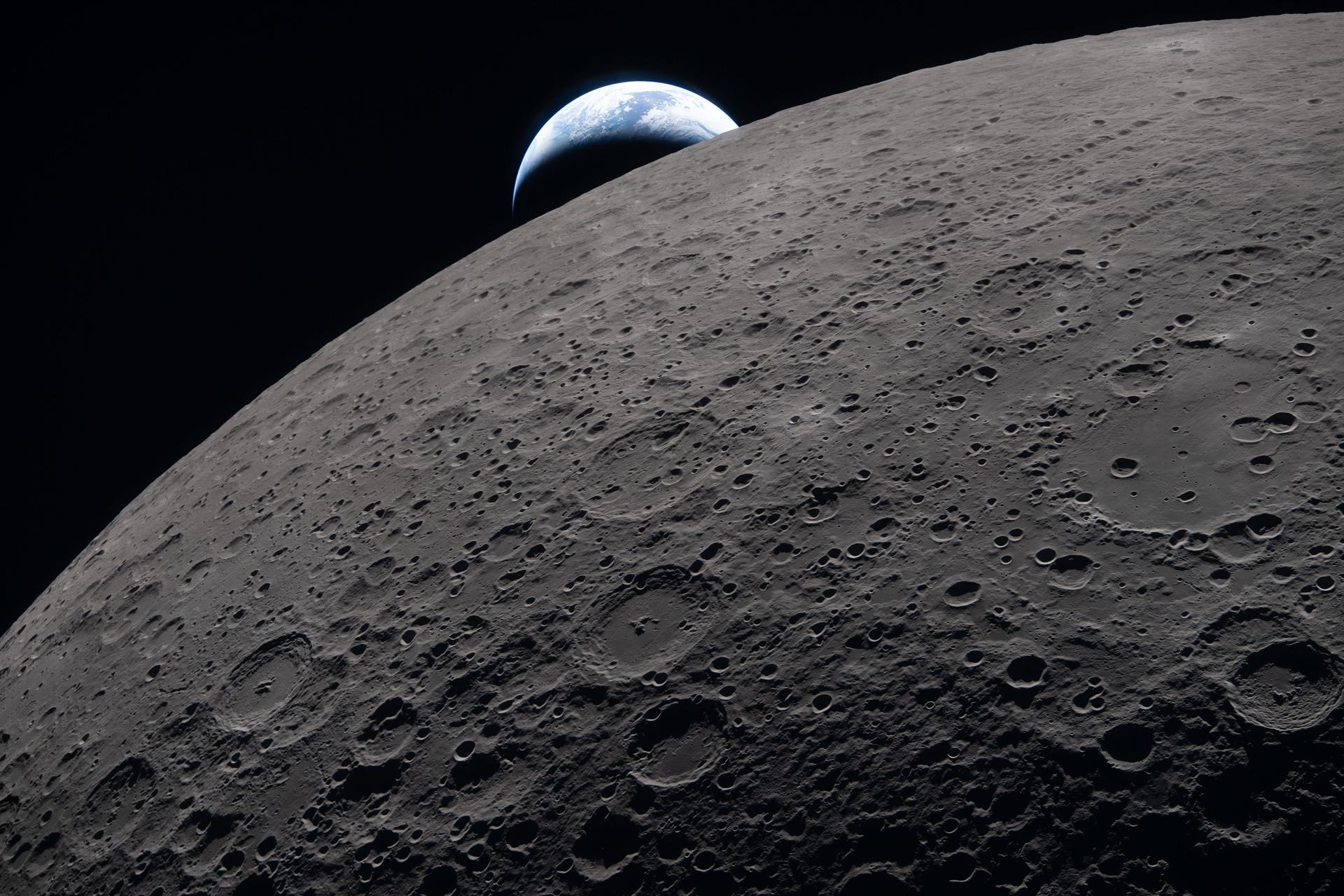

NASA’s Artemis II mission represents the next major leap in humanity’s return to deep space. As the first crewed mission in the Artemis program, Artemis II will send four astronauts aboard the Orion spacecraft on a journey around the Moon, testing critical systems needed for future lunar landings and long-term exploration.
Unlike its predecessor, Artemis I, which flew without astronauts, Artemis II places humans back on a trajectory beyond low-Earth orbit for the first time since the Apollo era. The mission will validate life-support systems, navigation, communication, and crew operations in deep space laying the foundation for future landings near the Moon’s south pole.
A Powerful Rocket for a Historic Journey
Source: NASA Image LibraryArtemis II will launch aboard NASA’s powerful Space Launch System (SLS), currently the most capable rocket ever built by the agency. Designed to carry astronauts and cargo beyond Earth’s orbit, SLS provides the thrust needed to send Orion on a multi-day trajectory around the Moon and safely return the crew home.
During the mission, astronauts will travel thousands of kilometres beyond the lunar far side—farther than any humans have journeyed in decades. The flight will follow a free-return trajectory, ensuring the spacecraft naturally loops back toward Earth even in the event of propulsion issues.
This carefully planned route balances safety with mission objectives, allowing NASA engineers to test spacecraft performance in real deep-space conditions.
Meet the Artemis II Crew
Source: NASA Image LibraryThe Artemis II mission will carry four astronauts representing both the United States and international partnership:
- Reid Wiseman (Commander)
- Victor Glover (Pilot)
- Christina Koch (Mission Specialist)
- Jeremy Hansen (Mission Specialist)
Their flight marks several milestones. Christina Koch will become the first woman to travel beyond low Earth orbit, while Jeremy Hansen will be the first Canadian astronaut to journey to the Moon.
Together, the crew represents the collaborative spirit of modern space exploration, highlighting the growing role of international partnerships in missions beyond Earth.
Why Artemis II Matters
Artemis II is more than a single mission it is a bridge between testing and landing. By proving that astronauts can safely travel aboard Orion in deep space, NASA prepares for Artemis III, which aims to return humans to the lunar surface for the first time since the Apollo missions.
The mission also supports long-term goals that extend beyond the Moon. Technologies validated during Artemis II will help shape future expeditions to Mars and establish a sustainable human presence in deep space.
With Artemis II, humanity takes another decisive step toward becoming a multi-world species returning not just to visit the Moon, but to stay and explore farther than ever before.
@KC Technical UK